Selecting a Cnc Multi-Edges Polishing Machine In Oman involves more than comparing spindle power or brochure speed. Workshops must consider edge consistency, abrasive availability, operator training, water use, and after-sales support. A polished slab may look flawless under showroom lights, yet reveal waviness beside a window. Small trial runs matter.
Oman’s National Centre for Statistics and Information publishes its Statistical Yearbook, while UNIDO’s International Yearbook of Industrial Statistics tracks manufacturing indicators. These sources help describe the country’s industrial context, but they do not rank individual polishing machines. Buyers should treat any “top 10” list as a shortlist, not an independent performance test. Taiichi Ohno, the Toyota manufacturing engineer, is widely credited with saying, “Where there is no standard, there can be no improvement.” For buyers, that principle points to measurable checks: edge flatness, finish uniformity, cycle time, and reject rate.
This guide compares ten machines through practical criteria, including material compatibility, multi-edge capacity, controls, maintenance access, and supplier responsiveness in Oman. It also flags where published specifications may not match daily workshop conditions. That gap deserves attention. A machine can perform well in a demonstration and still struggle with local workloads, consumable lead times, or uneven operator experience. Request sample processing, written service terms, and references from comparable users before committing. The right choice is not always the fastest model; it is the one that delivers repeatable edges with support your team can actually reach.
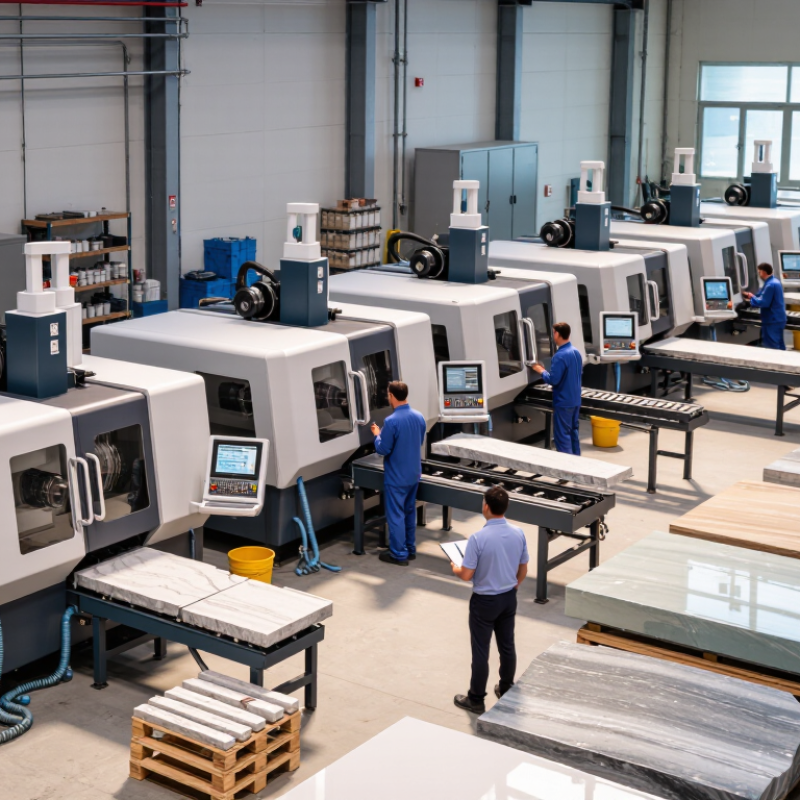
A CNC multi-edge polishing machine shapes and finishes several stone edges with programmed movement. In Oman, workshops may use one for marble, granite, and engineered stone countertops. The operator secures a slab, selects an edge profile, and sets the tool path. Depending on the machine configuration, it can grind, smooth, and polish straight or shaped edges in sequence. Small details matter. A slightly uneven slab or a poorly aligned clamp can leave visible differences along the finished edge.
Water-cooled processing helps control heat and remove stone dust from the cutting area. Operators should check water flow, abrasive wear, and workpiece support before a production run. The control system repeats programmed movements, but it cannot correct every setup mistake. Even a small change in material thickness may affect the result. Measure a sample piece first, then inspect the edge under clear light. Not always. A glossy finish can hide tiny waves until light catches them. Regular cleaning also matters in dusty workshops, where residue can affect guides and moving parts. Machine capability varies, so confirm the available axes, tooling, and supported edge profiles before choosing a setup.
Edge distribution on a standard rectangular glass panel
A rectangular panel has two long edges and two short edges. CNC multi-edge polishing machines can process selected edges using programmed settings; supported edge profiles and processing sequences depend on the machine configuration.
Key Criteria for Evaluating Machines Available in Oman
When comparing CNC multi-edge polishing machines in Oman, begin with the stone you actually process. Test a 20 mm granite slab and a softer marble sample, checking edge consistency, chipping, cycle time, and abrasive wear. Ask suppliers for measured output, not just maximum feed speed. Small details matter. Confirm the machine supports your required profiles and slab thicknesses, and that replacement abrasives and critical parts can be sourced locally or delivered predictably.
Utilities deserve equal attention. The IEA’s Energy Efficiency 2023 report estimates that industry uses about 37% of global energy, so compare machines by energy use per finished metre, not motor rating alone. Water recovery matters, too: WRI’s Aqueduct 4.0 identifies Oman as facing extremely high baseline water stress. Check whether the coolant system recirculates water, how easily filters can be cleaned, and where slurry collects. In a workshop, a blocked filter can quietly reduce finish quality. Verify three-phase electrical requirements, heat management, guarding, and operator training. Ask for a live acceptance test using your own stone. Supplier figures can look tidy; real production is less tidy. I would also confirm service response times in writing, since an impressive machine is less useful when a small sensor fault stops the line.
Top 10 CNC Multi-Edge Polishing Machines in Oman
Choosing among the top 10 CNC multi-edge polishing machines in Oman means checking performance against the stone and daily workload. A machine should hold slabs firmly while its heads follow straight edges, mitres, and shaped profiles. Ask suppliers for sample runs using your own stone. Watch the corners closely. Small chips can appear even when the main edge looks smooth.
For workshops handling marble, granite, or engineered stone, compare spindle power, head count, feed speed, and water delivery. More heads may raise output, but only when operators can load slabs consistently and maintain each polishing wheel. Oman’s heat and airborne dust also make sealed electrical components, accessible filters, and dependable cooling practical priorities. One detail is often missed: confirm the machine’s footprint, drainage needs, and service access before installation.
Dust control deserves equal attention. OSHA’s Respirable Crystalline Silica standard sets a benchmark exposure limit of 50 micrograms per cubic metre over eight hours; its fact sheet also identifies water-based controls as a key measure during stone processing. This is a U.S. workplace reference, not a substitute for Omani requirements. Ask for documented water flow, guarding, emergency stops, and noise data. Request a trial on a representative slab, then inspect edge consistency, water use, and changeover time. Real results matter more than brochure speed.
This is a brand-neutral comparison of common CNC machine configurations for edge finishing. It is not a verified sales ranking, and local stock or model-specific capabilities should be confirmed with suppliers in Oman.
| No. | Machine Configuration | Typical Material | Edge Operations | Typical Applications | Checks for Buyers in Oman |
|---|---|---|---|---|---|
| 1 | CNC straight-line glass edging machine | Flat glass | Straight-edge grinding, polishing, and arrissing, depending on the installed tooling | Architectural glazing, doors, partitions, and furniture glass | Confirm glass thickness range, edge finish, water management, and electrical compatibility with the workshop supply. |
| 2 | CNC glass beveling machine | Flat glass and mirror glass | Bevel grinding and polishing along straight edges | Decorative mirrors, interior panels, and furniture components | Check achievable bevel width and angle, edge quality, glass-size limits, and consumable availability. |
| 3 | CNC glass corner and shape edging machine | Flat glass | Edge grinding and polishing on programmed contours, subject to machine configuration | Shaped panels, rounded corners, and custom interior glass | Request a sample run using the intended glass type and confirm the supported CAD/CAM workflow. |
| 4 | CNC stone straight-edge polishing machine | Granite, marble, and other dimension stone | Straight-edge calibration, grinding, and polishing | Countertops, vanity tops, and stone panels | Verify slab thickness capacity, abrasive compatibility, water recirculation, and slurry handling. |
| 5 | CNC stone profile and bullnose edge polisher | Granite, marble, and engineered stone | Bullnose, eased, and other supported edge profiles | Kitchen countertops, counters, and architectural stonework | Confirm available profile tooling, repeatability, workpiece support, and dust or slurry controls. |
| 6 | CNC multi-profile stone edge machine | Natural and engineered stone | Multiple programmed edge profiles using compatible tooling | Custom countertops, stair components, and decorative stone pieces | Check profile-change time, tool availability, control-language support, and operator training. |
| 7 | CNC ceramic and porcelain tile edge polisher | Ceramic tile and porcelain slabs | Straight-edge grinding, polishing, and selected bevel operations | Tile fabrication, cladding, and large-format surface projects | Test the actual tile material for chipping; verify thickness range, water supply, and waste-water handling. |
| 8 | CNC sheet-metal edge deburring and finishing machine | Steel, stainless steel, aluminium, and other supported sheet metals | Burr removal and edge rounding; finishing depends on the abrasive arrangement | Fabricated panels, enclosures, and cut sheet-metal parts | Confirm material and thickness compatibility, extraction requirements, and whether both sides can be processed. |
| 9 | CNC tube and profile end-finishing machine | Metal tube and structural profiles | Deburring and finishing of cut ends and accessible edges | Fabrication, handrails, frames, and metal furniture | Check supported cross-sections, clamping method, abrasive type, and required surface finish. |
| 10 | CNC router with edge-rounding and polishing tooling | Wood, plastics, solid-surface panels, and selected composites | Programmed edge rounding, trimming, and polishing where compatible tooling is installed | Furniture, signage, counters, and panel fabrication | Confirm spindle and tool compatibility, workholding, dust extraction, and the finish achievable on the chosen material. |
Before purchase, compare the machine’s documented material range, working dimensions, tooling, safety features, installation requirements, service support, and electrical requirements with your production needs and site conditions.
Stone yards and fabricators serving Oman’s construction market work with marble, granite, and limestone. CNC multi edge polishing machines can finish several slab edges with repeatable profiles. That matters for kitchen counters, reception desks, stair treads, and window surrounds, where clean edges are highly visible. On a busy workshop floor, consistent finishing can reduce handwork and help prepare pieces for installation.
The same equipment can support tile and interior fit-out production. Operators may polish straight edges, bevels, or selected profiles for wall cladding and flooring components. Manufacturing workshops can also use CNC edge finishing for stone panels made to project drawings. Each material behaves differently, though. A profile that works well on dense granite may need adjustments for softer limestone.
Good results depend on more than the machine. Tool choice, feed speed, water flow, and careful calibration all affect the finish. Dust still matters. So does operator skill. A polished edge can hide small flaws under workshop lighting, then show them beside a bright window. That is an easy detail to overlook. Buyers should check sample pieces and confirm the machine’s capacity matches their common slab sizes, edge shapes, and daily production needs.
Installing a multi-edge polishing machine in Oman starts with the site, not the cutting tools. Check floor level, anchor points, drainage, and electrical capacity before delivery. Fine stone dust can settle on linear guides, while coastal air may accelerate corrosion on exposed surfaces. Seal cable entries and keep control cabinets clear of grinding water. Leave enough space to remove polishing heads safely. Small details matter.
During operation, record spindle load, water flow, edge finish, and tool changes by shift. The International Energy Agency’s 2011 report, Energy-Efficiency Policy Opportunities for Electric Motor-Driven Systems, estimates that motor-driven systems use about 46% of global electricity. It is a broad benchmark, not an Oman-specific figure, but it supports monitoring idle time and motor loads. For pneumatic systems, the U.S. Department of Energy’s 2003 Compressed Air Sourcebook notes that leaks may waste 20–30% of compressor output. Check fittings and air pressure regularly. Maintenance intervals should reflect dust, workload, and observed wear; a fixed calendar alone can miss early problems. Even careful teams sometimes overlook water deposits on sensors. Review them.
Test a 20 mm granite slab and a marble sample. Check edge consistency, chipping, cycle time, and abrasive wear. Watch the corners.
Not by itself. Ask for measured output on your own stone. Real production can be less tidy than supplier figures.
Check whether the coolant system recirculates water. Ask about flow, filter cleaning, and where slurry collects. Filters matter.
Compare spindle power, polishing-head count, feed speed, and water delivery. More heads help only when loading and maintenance stay consistent.
Confirm floor level, anchor points, drainage, and electrical capacity. Leave room to remove polishing heads safely. Measure the footprint.
Look for accessible filters, reliable cooling, and sealed electrical components. Keep stone dust away from linear guides and grinding water away from control cabinets.
Track spindle load, water flow, edge finish, and tool changes. Check air fittings for leaks if the machine uses pneumatic systems.
Set intervals based on dust, workload, and visible wear. Clean water deposits from sensors. I might be focusing too much on the calendar. Watch what the machine shows.
This article explores how a Cnc Multi-Edges Polishing Machine In Oman can help produce smooth, consistent finishes on stone and other manufactured materials. It explains the machines’ core functions, including automated edge shaping and polishing, and outlines key factors to consider when comparing options available in Oman, such as processing capacity, precision, ease of operation, and suitability for different materials. The overview also presents ten machine types and configurations, focusing on their practical features rather than specific brands.
The article considers applications across Oman’s stone-processing and manufacturing industries, where reliable edge finishing can support both custom work and larger production runs. It also covers local installation and day-to-day operating needs, including workspace preparation, operator training, routine inspection, and preventive maintenance. Together, these topics offer readers a practical starting point for assessing equipment, planning its use, and selecting a solution that fits their production requirements.

Dingzhu auto