Choosing the right Cnc Machine Polishing Tools can determine whether a finished surface looks precise or merely acceptable. In CNC production, polishing is not a final cosmetic gesture. It affects surface roughness, dimensional stability, tool marks, heat control, and the time required for manual correction. A mirror finish may demand different abrasives than a controlled satin surface. Material matters too. Aluminum, stainless steel, hardened steel, and carbide each respond differently under pressure and speed.
W. Edwards Deming, a respected manufacturing quality expert, said, “Quality comes not from inspection, but from the improvement of the production process.” This principle remains valuable when selecting polishing brushes, abrasive wheels, diamond compounds, felt bobs, and automated finishing heads. The best tool is rarely the most aggressive one. It is the tool that delivers repeatable results without damaging edges or blocking coolant flow.
Small details matter. A worn pad can create uneven swirls. Excessive pressure can blur a sharp corner. Poor grit progression wastes hours. Sometimes, even experienced operators choose the wrong abrasive. That deserves honest reflection.
This guide examines the top 10 Cnc Machine Polishing Tools used for controlled, efficient finishing. Each option will be considered through practical factors, including material compatibility, surface quality, machine integration, service life, safety, and maintenance. The ranking is useful, but not absolute. Actual results depend on programming, workholding, operator skill, and the condition of the machine. Expect helpful comparisons, not promises.
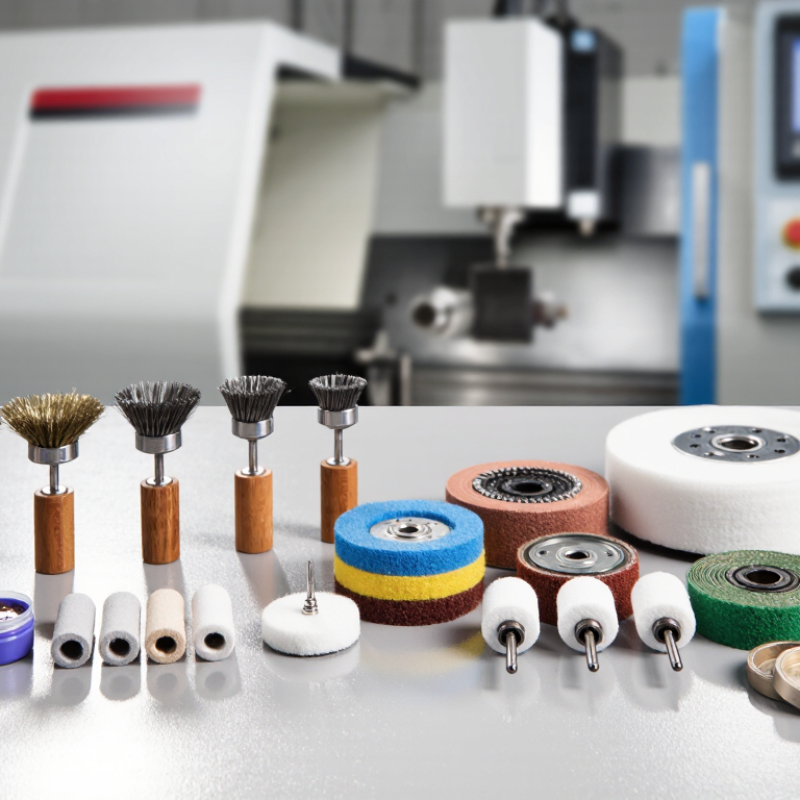
CNC Polishing Tools Explained: 10 Types and ISO 21920 Ra 0.8–0.05 µm
CNC polishing tools control more than shine; they shape measurable surface texture. In practical machining, I select the tool according to material, geometry, and required ISO 21920 Ra value. Abrasive belts remove machining marks quickly. Flap wheels blend curved areas. Nonwoven wheels create a controlled satin finish. Felt wheels support fine polishing with liquid compound. Abrasive discs work well on broad, accessible faces.
The finer range needs steadier control. Mounted points reach small pockets and edges. Abrasive stones correct narrow grooves and hardened surfaces. Diamond paste on a polishing pad can approach Ra 0.05 µm on suitable materials. Lapping films provide consistent micro-abrasion on flat surfaces. Abrasive brushes follow threads, slots, and irregular profiles. These are ten distinct tool types, but none guarantees a specific result alone.
ISO 21920 Ra 0.8–0.05 µm requires measurement, not visual judgment. I normally reduce feed, pressure, and abrasive size in stages. Coolant selection also matters. Heat can smear soft alloys and hide defects temporarily. A stylus instrument should verify the result across several directions. The target may look perfect, yet measure poorly. I have seen this mistake after over-polishing an edge. Tool runout, worn abrasives, and unstable fixturing can also raise Ra. Process records make the next setup more reliable.
What Are the Top 10 CNC Machine Polishing Tools?
The chart compares common CNC polishing and finishing tool types by their typical lower achievable surface roughness. Lower Ra values indicate a smoother surface. Actual results depend on material, tool condition, cutting speed, feed rate, pressure, coolant, and process sequence. The values are approximate and aligned with surface-finish ranges commonly referenced under ISO 21920 terminology.
How to Select Tools by Material, Grit Size, and 0.01 mm Runout
Selecting the right CNC machine polishing tool starts with the workpiece material, not the tool drawer. Hard steels often respond well to diamond files, ceramic stones, carbide burrs, abrasive brushes, and fine lapping films. Softer aluminum needs lighter pressure and open-structure abrasive wheels. Otherwise, the surface can load quickly and smear.
Grit size controls both cutting speed and surface appearance. Coarse grits remove milling marks, while medium grits refine scratches. Fine grits create the final sheen with less material removal. A practical ten-tool set may include diamond files, mounted points, flap wheels, felt buffs, abrasive brushes, lapping films, ceramic stones, carbide burrs, polishing discs, and nonwoven wheels. Do not jump directly from 120 grit to 1,000 grit. Deep scratches may remain visible under bright inspection light.
Runout deserves equal attention. For precision polishing, measure the assembled holder and tool near the working end. A target within 0.01 mm helps maintain even contact, especially on narrow edges and curved cavities. Excessive runout creates bands, heat, and uneven gloss. I once blamed the abrasive for a patchy finish, but the real problem was a worn collet. Check the spindle, holder, and tool together. Small details matter. Work at moderate speed, clean between grits, and inspect the surface after every stage. Results can still vary with pressure, coolant, and operator control.
Top 10 CNC Polishing Tools: Abrasive Types, Uses, and Finish Ranges
What Are the Top 10 CNC Machine Polishing Tools?
CNC polishing starts with the abrasive, not the machine brand. The top ten choices are bonded abrasive wheels, flap wheels, abrasive belts, nonwoven wheels, ceramic-fiber discs, mounted stones, diamond wheels, felt wheels, diamond paste, and lapping films. Bonded wheels remove weld marks and scale, usually reaching Ra 1.6–6.3 μm. Flap wheels blend edges at about Ra 0.8–3.2 μm. Belts suit flat panels and curved housings, producing Ra 0.4–3.2 μm. Nonwoven wheels create a satin texture, commonly between Ra 0.8 and 3.2 μm.
Ceramic-fiber discs cut hard stainless steel efficiently, often reaching Ra 0.4–1.6 μm. Mounted stones polish slots and small radii, with typical results near Ra 0.4–1.6 μm. Diamond wheels handle carbide and hardened alloys, sometimes reaching Ra 0.1–0.8 μm. Felt wheels, used with compound, can produce Ra 0.05–0.4 μm. Diamond paste and lapping films support mirror finishing, sometimes below Ra 0.1 μm. These ranges depend on pressure, feed rate, coolant, and measurement direction. According to Grand View Research’s 2024 abrasives market assessment, the global market was valued at more than USD 45 billion in 2023. ISO 21920 also emphasizes controlled roughness measurement. Report figures remain directional. Real shop results can disagree. A practical test coupon still matters more than a catalog promise.
Comparing Tool Life and Cutting Speeds from 6,000 to 30,000 rpm
Choosing among the top 10 CNC machine polishing tools depends on more than surface finish. Tool life changes sharply between 6,000 and 30,000 rpm. The practical range includes carbide burrs, diamond files, abrasive stones, flap wheels, mounted points, nylon brushes, felt bobs, ceramic discs, lapping films, and polishing belts. Each tool responds differently to heat, pressure, and workpiece hardness.
At 6,000 to 12,000 rpm, abrasive stones and flap wheels usually provide stable cutting on larger surfaces. Their wider contact area helps prevent sudden heat buildup. A medium-grit flap wheel may last 30 to 60 minutes during light aluminum finishing. Ceramic discs can remove material faster, but excessive pressure shortens their life quickly. For narrow grooves, carbide burrs cut efficiently at 12,000 to 18,000 rpm. I have found that a dull burr often leaves more heat marks than visible scratches.
Small diamond tools and polishing points perform better from 18,000 to 30,000 rpm. They produce cleaner edges on hardened steel, especially near holes and corners. However, their service life may fall below 20 minutes when coolant flow is poor. Felt bobs and lapping films need gentle pressure, not maximum speed. Speed alone misleads. A 10 mm tool at 30,000 rpm creates far more surface speed than a 30 mm wheel at 10,000 rpm. My early comparisons also showed inconsistent results because operators used different feed pressures. A controlled test should record diameter, material, grit, pressure, temperature, and finish readings. Even then, tool-life data remains a working estimate, not a promise.
What Are the Top 10 CNC Machine Polishing Tools? - Comparing Tool Life and Cutting Speeds from 6,000 to 30,000 rpm
| Rank |
Polishing Tool Type |
Typical Abrasive / Construction |
Suitable Materials |
Typical Diameter |
Recommended Speed |
Surface Speed
at 6,000 rpm |
Surface Speed
at 30,000 rpm |
Typical Tool Life |
Best Finishing Use |
| 1 |
Diamond-Coated Ball-Nose Tool |
Electroplated diamond particles on carbide |
Glass, ceramics, graphite, carbon fiber, hardened composites |
3–10 mm |
12,000–30,000 rpm |
113–188 m/min |
565–942 m/min |
40–120 min |
3D contours and fine edge blending |
| 2 |
Diamond Burr |
Sintered or electroplated diamond grit |
Stone, glass, ceramic, carbide, hardened steel |
2–8 mm |
15,000–30,000 rpm |
38–151 m/min |
188–754 m/min |
30–100 min |
Small radii, slots, holes, and intricate details |
| 3 |
Carbide Deburring and Polishing Burr |
Solid carbide with polished cutting edges |
Aluminum, brass, plastics, stainless steel, mild steel |
3–12 mm |
10,000–24,000 rpm |
57–226 m/min |
283–905 m/min |
60–180 min |
Deburring and removal of light tool marks |
| 4 |
Rubberized Abrasive Point |
Aluminum oxide or silicon carbide in an elastic binder |
Steel, stainless steel, aluminum, titanium |
6–20 mm |
6,000–18,000 rpm |
113–377 m/min |
565–1,131 m/min |
45–150 min |
Blending scratches and preparing metal for polishing |
| 5 |
Abrasive Flap Wheel |
Overlapping coated-abrasive cloth flaps |
Aluminum, stainless steel, carbon steel, wood, plastic |
20–50 mm |
6,000–12,000 rpm |
377–942 m/min |
1,885–3,770 m/min |
20–90 min |
Uniform satin finishes and surface blending |
| 6 |
Abrasive Nylon Brush |
Nylon filaments impregnated with abrasive grit |
Aluminum, brass, stainless steel, plastics, wood |
25–75 mm |
6,000–12,000 rpm |
471–1,414 m/min |
2,356–7,069 m/min |
60–240 min |
Deburring without significantly changing part geometry |
| 7 |
Felt Bob with Polishing Compound |
Compressed wool felt used with abrasive compound |
Stainless steel, aluminum, copper, brass, precious metals |
10–30 mm |
6,000–18,000 rpm |
188–565 m/min |
942–2,827 m/min |
10–60 min |
Bright finishing and removal of fine haze |
| 8 |
Ceramic Fiber Finishing Wheel |
Nonwoven ceramic abrasive fibers |
Stainless steel, nickel alloys, titanium, aluminum |
20–50 mm |
6,000–15,000 rpm |
377–942 m/min |
1,885–4,712 m/min |
30–120 min |
Weld blending and directional surface finishing |
| 9 |
Diamond Cup Wheel |
Segmented or continuous diamond abrasive rim |
Concrete, stone, glass, ceramics, engineered composites |
40–100 mm |
6,000–10,000 rpm |
754–1,885 m/min |
3,770–9,425 m/min |
60–300 min |
Large-area leveling and edge correction |
| 10 |
Lapping Disc or Flexible Abrasive Disc |
Resin-bonded abrasive or flexible diamond film |
Hardened steel, carbide, glass, ceramics, optical materials |
25–75 mm |
6,000–15,000 rpm |
471–2,356 m/min |
2,356–7,069 m/min |
15–100 min |
Final flat-surface refinement and low-roughness finishing |
Technical note: Surface speed is calculated as
V = π × D × n ÷ 1,000, where V is measured in m/min, D is tool diameter in mm, and n is spindle speed in rpm. Tool-life figures are typical planning ranges for light finishing operations and can vary substantially with abrasive grade, workpiece material, contact pressure, coolant, chip evacuation, and machine rigidity.
Quality Checks: Ra Measurement, Edge Control, and ±0.01 mm Tolerance
What Are the Top 10 CNC Machine Polishing Tools?
The most useful CNC polishing tools include abrasive belts, flap wheels, polishing discs, mounted stones, diamond files, lapping films, abrasive brushes, felt wheels, ceramic stones, and micro-abrasive pads. Each tool leaves a different surface pattern. A bright finish does not always mean a precise finish. I have seen parts look flawless under workshop lighting while failing Ra inspection.
Quality checks should begin with a calibrated roughness tester and a clean, stable surface. Measure Ra in several directions, especially across visible tool marks. Record the cutoff length and measuring location. One reading is not enough. Edge control also matters. Excessive polishing can round a sharp corner or remove material near a slot. Use a small radius gauge or optical comparator when the edge is critical. For ±0.01 mm tolerance, measure before and after polishing with suitable calibrated equipment. Temperature, clamping pressure, and operator force can affect results.
Tips: Mark inspection points on the drawing. Keep the same polishing pressure during trials. Check edges under magnification. Do not trust appearance alone. If results vary, review tool wear, spindle speed, abrasive size, and measurement technique. This step is often overlooked. A polished part may still require process adjustment. My own checks have shown that the last finishing pass sometimes creates the largest dimensional change.
FAQS
Start with the workpiece material. Hard steel may suit diamond files, ceramic stones, or carbide burrs. Aluminum needs lighter pressure and open-structure wheels. Otherwise, abrasive loading and smearing may occur.
Coarse grit removes milling marks quickly. Medium grit refines visible scratches. Fine grit creates a smoother sheen with less material removal. Do not jump from 120 grit to 1,000 grit. Deep scratches may remain under bright light.
Abrasive belts suit flat panels and curved housings. Flap wheels blend edges. Mounted stones reach slots and small radii. Nonwoven wheels create a satin texture. Felt wheels support final polishing with compound.
Runout describes how much the assembled tool deviates while rotating. Measure the holder and tool near the working end. A target within 0.01 mm supports even contact. Excessive runout can create bands, heat, and uneven gloss.
Bonded wheels may produce Ra 1.6–6.3 μm. Flap wheels often reach Ra 0.8–3.2 μm. Fine diamond tools may reach Ra 0.1–0.8 μm. Felt wheels, paste, and lapping films can create finer surfaces. Actual results vary.
Use a calibrated roughness tester on a clean, stable surface. Measure in several directions across visible tool marks. Record the cutoff length and location. One reading is not enough. Appearance can mislead.
Mark inspection points on the drawing. Check critical edges under magnification. Use a radius gauge or optical comparator when needed. Measure dimensions before and after polishing. Excessive finishing can round corners or enlarge slots.
Check spindle speed, pressure, coolant, abrasive size, and tool wear. Inspect the spindle, holder, and collet together. Clean between grit changes. I once blamed the abrasive, but a worn collet caused the patchy finish. Small errors matter.
Conclusion
Cnc Machine Polishing Tools are essential for achieving controlled surface finishes, accurate edges, and repeatable results in automated manufacturing. This guide explains ten major tool types, including abrasive stones, mounted wheels, polishing brushes, abrasive belts, diamond tools, and flexible finishing media. It also shows how to select the right option according to workpiece material, grit size, tool geometry, and a target runout of 0.01 mm. Surface performance is evaluated through ISO 21920 roughness values, covering finishes from approximately Ra 0.8 to Ra 0.05 µm.
The article compares tool life, material removal, and cutting performance at spindle speeds ranging from 6,000 to 30,000 rpm. It also presents practical methods for controlling heat, preventing edge rounding, and maintaining consistent contact during polishing. Final quality checks include Ra measurement, edge inspection, dimensional verification, and tolerance control within ±0.01 mm, helping manufacturers choose tools that balance finish quality, productivity, durability, and process stability.

 Dingzhu auto