Top 10 Cloth Wheel Polishing CNC Lathe Machine Types

Time:2026-09-17 Author:Liam
0%

Choosing the right Cloth Wheel Polish Cnc Spinning Lathe Machine can shape surface quality, production speed, and operating costs. A polished wheel may look simple, yet its performance depends on spindle stability, wheel pressure, rotation control, and workpiece alignment. Small errors often leave visible rings, uneven brightness, or heat marks on metal surfaces.

This introduction previews ten common machine types used in cloth wheel polishing operations. The comparison considers vertical and horizontal structures, single-wheel and multi-wheel layouts, manual loading, automatic feeding, and servo-controlled systems. It also examines polishing wheel diameter, motor power, programmable speed, dust collection, and maintenance access. These details matter on a busy workshop floor, where cotton fibers collect around the spindle and a loose fixture can reduce consistency.

Dr. Yoram Koren, a respected manufacturing-systems authority, stated, “The factory of the future must be flexible.” That principle applies here. A machine should match the material, batch size, finish requirement, and operator skill, not merely its advertised speed. Experienced technicians check vibration with a running wheel, inspect the contact path, and test several workpieces before approving production. They also question their first choice.

No single design suits every factory. Some recommendations may change after real testing. The following guide therefore compares practical strengths, limitations, control features, and suitable applications for each Cloth Wheel Polish Cnc Spinning Lathe Machine type. Its purpose is not to promote the most expensive model, but to support a safer, more informed purchasing decision.
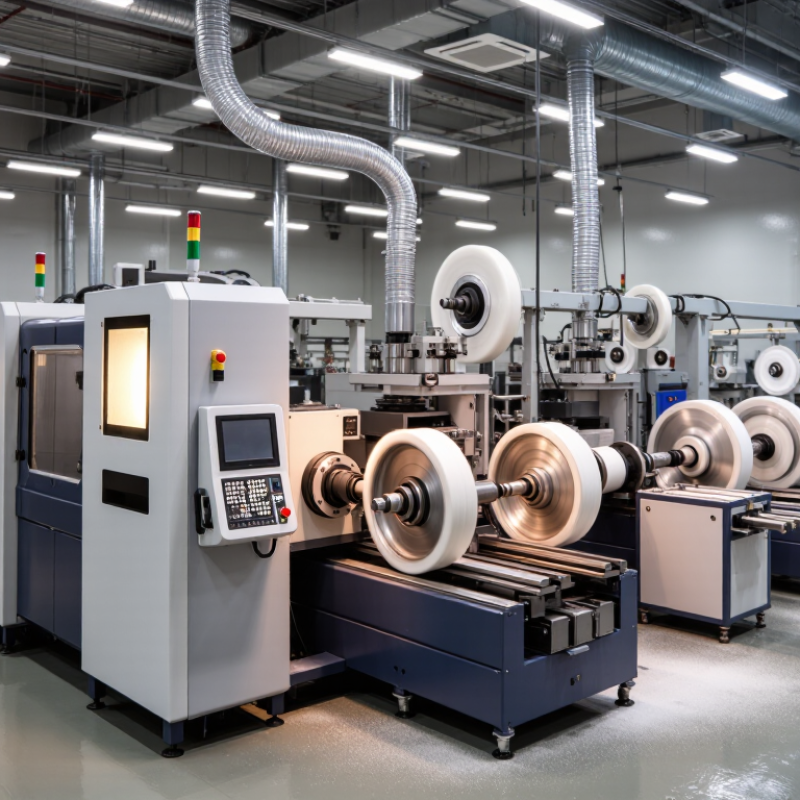
Top 10 Cloth Wheel Polishing CNC Lathe Machine Types

Definition and Working Principle of Cloth Wheel Polishing CNC Lathes

A cloth wheel polishing CNC lathe is a computer-controlled machine for refining round metal surfaces. It uses rotating cloth wheels, abrasive compound, and programmed tool movement. The result is a smoother, brighter, and more uniform finish. Common types include single-wheel, twin-wheel, vertical, horizontal, automatic loading, and multi-station configurations.

Its working principle is precise but practical. The chuck holds and rotates the workpiece at a controlled speed. A cloth wheel spins separately and contacts the surface with measured pressure. CNC commands regulate wheel travel, feed rate, spindle speed, and polishing cycles. Abrasive compound transfers to the cloth, removing fine marks through repeated contact. A sensor or operator may check diameter, gloss, temperature, and surface consistency during production.

Small details affect the finish. Excessive pressure can create heat, rounded edges, or uneven reflections. Too little compound may leave visible machining lines. Experienced technicians often adjust the feed rate after inspecting the first part, even when the program appears correct. That judgment matters. Not perfect yet. Cloth wear also changes polishing behavior, so scheduled dressing and replacement are essential. In real workshops, vibration, contamination, and incorrect workholding can reduce accuracy. A reliable process combines stable fixturing, clean compound control, documented settings, and regular inspection.

Key Components and Control Systems in Polishing CNC Lathe Machines

Cloth wheel polishing CNC lathes vary by spindle layout, wheel size, and workpiece capacity. Horizontal models suit shafts and round components. Vertical types offer better support for heavier parts. Multi-wheel machines can perform coarse polishing, fine polishing, and edge treatment in one setup. The central components include a rigid bed, precision spindle, arbor, cloth wheel, servo motor, and workholding chuck. Each part affects surface consistency.

The spindle must maintain stable speed under changing contact pressure. A small vibration can create visible rings on a polished surface. Adjustable wheel pressure helps prevent burning, tearing, or uneven gloss. Compound delivery systems apply polishing material near the contact zone. Dust extraction protects the operator and keeps abrasive particles away from guideways. Guards should allow inspection without exposing moving wheels.

The control system connects the machine’s motion and polishing behavior. CNC software controls spindle speed, feed rate, wheel position, and polishing time. Servo feedback helps correct small positioning errors during repeated cycles. A PLC manages interlocks, door sensors, overload alarms, and emergency stops. Operators often adjust parameters after checking the actual finish, not only the program screen. This matters because cloth density, heat, and compound buildup can change results. Perfect settings rarely remain perfect. A practical technician records each correction and questions whether the wheel, fixture, or program caused the defect.

Top Cloth Wheel Polishing CNC Lathe Types by Structure and Function

Cloth wheel polishing CNC lathes differ mainly by structure and working function. Ten useful types include horizontal, vertical, twin-spindle, single-spindle, turret, multi-station, centerless, robotic, enclosed, and custom-axis models. Horizontal machines suit long shafts and steady wheel contact. Vertical designs handle heavy, short parts with easier loading. Twin-spindle machines polish two surfaces in one cycle. Turret and multi-station structures reduce manual tool changes. Centerless layouts support continuous production, but they demand accurate wheel alignment.

Function also separates these machines. Rough-polishing models remove visible machining marks. Fine-polishing models create smoother reflective surfaces. Edge-polishing units target rims, grooves, and narrow shoulders. Robotic systems manage irregular parts and repeatable loading. Enclosed machines control cloth dust and improve operator protection. Grand View Research reported that the global CNC machine market reached about USD 83.8 billion in 2023, with strong growth forecast through 2030. That growth reflects automation demand, not guaranteed polishing quality. The wrong spindle speed can still burn a metal edge.

Tips: Match the wheel diameter, cloth density, spindle torque, and workpiece geometry before purchase. The ISO 230-1 standard provides useful guidance for machine accuracy tests. Record pressure, compound quantity, and cycle time during trials. A 2024 manufacturing survey by Deloitte found that skilled-worker shortages remain a major automation driver. Still, fully automatic polishing is not always better. Complex parts may need slower human inspection. Calibration records should be checked weekly, although many workshops neglect them.

Top 10 Cloth Wheel Polishing CNC Lathe Machine Types - Top Cloth Wheel Polishing CNC Lathe Types by Structure and Function
No. Machine Type Structural Configuration Typical CNC Axes Typical Workpiece Size Cloth Wheel Arrangement Primary Function Typical Applications Main Advantages
1 Horizontal Spindle Cloth Wheel Polishing Lathe Horizontal bed with a rotating workholding spindle and a cross-slide polishing head 2–4 controlled axes Up to approximately 300 mm diameter and 800 mm length One or two wheels mounted on a horizontal arbor External cylindrical polishing and finishing Shafts, tubes, handles, rods, and cylindrical fittings Versatile layout, straightforward loading, and good control of axial polishing paths
2 Vertical Rotary-Table Polishing CNC Lathe Vertical column with a rotary table supporting the workpiece below the polishing spindle 3–5 controlled axes Approximately 100–600 mm diameter and up to 250 mm height Vertical wheel stack with adjustable radial and angular movement Face, rim, and contoured-surface polishing Discs, cookware, flanges, covers, and decorative circular parts Stable support for heavy parts and convenient access to horizontal surfaces
3 Twin-Spindle Cloth Wheel Polishing Machine Two independently driven polishing spindles arranged on opposite or parallel sides 3–6 controlled axes Approximately 50–400 mm diameter for small and medium parts Two wheels using different compounds or staged polishing grades Rough polishing and final bright finishing in one cycle Faucets, fittings, automotive trim, hardware, and metal accessories Shorter cycle times and reduced manual transfer between operations
4 Turret-Type Multi-Station Polishing CNC Lathe Servo turret carrying several polishing wheels, brushes, or compound applicators 4–8 controlled axes Approximately 20–250 mm diameter and up to 500 mm length Multiple wheels with different diameters, densities, or abrasives Sequential polishing, deburring, blending, and bright finishing Complex fittings, precision hardware, decorative components, and valve parts Combines several processes with automatic tool selection and repeatable paths
5 Centerless Cloth Wheel Polishing CNC Machine Workpiece supported between regulating, contact, and guide components without a conventional chuck 2–5 controlled axes Typically 3–100 mm diameter and continuous bar or batch lengths Contact wheels positioned above or beside the supported workpiece Continuous polishing of round parts and long cylindrical surfaces Pins, rods, tubes, wires, rollers, and small shafts High throughput, consistent contact, and minimal chucking time
6 Double-Sided Cloth Wheel Polishing Lathe Workholding fixture positioned between two opposing polishing heads 4–6 controlled axes Approximately 20–350 mm diameter and up to 150 mm thickness Paired wheels operating on opposite faces or sides Simultaneous two-sided polishing and edge blending Discs, rings, brake components, covers, and flat metal parts Balanced processing, fewer handling steps, and improved surface uniformity
7 Profile-Following 5-Axis Polishing CNC Lathe Multi-axis head and rotary workholding system coordinated through programmed tool paths 5 controlled axes Approximately 30–500 mm envelope, depending on part geometry Articulated wheel head maintaining contact with curved surfaces Polishing of freeform, curved, and compound surfaces Moulds, sculpted fittings, turbine-like parts, and complex decorative components Handles complex geometry while maintaining controlled contact angle and pressure
8 Automatic Chucking and Bar-Feed Polishing Lathe CNC spindle combined with bar feeder, collet chuck, or automatic loading and unloading unit 3–6 controlled axes Typically 5–80 mm diameter for repetitive production One or more wheels with programmable feed and dwell cycles Unattended polishing of repeated parts from bar or blanks Fasteners, pins, small shafts, knobs, and standard turned components Improves labor efficiency, production consistency, and machine utilization
9 Large-Diameter Heavy-Duty Polishing CNC Lathe Rigid reinforced bed, large spindle, steady rest, and heavy polishing carriage 3–5 controlled axes Approximately 300–1,500 mm diameter and up to 3,000 mm length Large-diameter cloth wheels with adjustable pressure and traverse speed Heavy stock blending, scale removal, and finishing of large surfaces Large tubes, tanks, rollers, rings, vessels, and industrial fabrications High rigidity, stable operation, and capacity for oversized workpieces
10 Modular Robotic Cloth Wheel Polishing CNC Cell CNC polishing spindle integrated with a robot, fixture station, compound system, and enclosure 6-axis robot plus 1–3 auxiliary axes Approximately 20–800 mm envelope, based on robot reach and fixture design Quick-change wheels or multi-wheel tool packages with controlled compliance Flexible automated polishing for varied shapes and production batches Automotive parts, sanitary fittings, furniture hardware, and mixed product lines Flexible programming, reduced operator exposure, and easy integration with inspection systems
Technical note: Dimensions, axis counts, and capacity ranges are representative specifications for generic CNC cloth wheel polishing configurations. Actual values depend on workholding, wheel diameter, spindle power, material, surface condition, and the required finish.

How to Select a Cloth Wheel Polishing CNC Lathe for Specific Applications

Top 10 Cloth Wheel Polishing CNC Lathe Machine Types

Selecting a cloth wheel polishing CNC lathe starts with the workpiece, not the machine catalog. Measure its diameter, length, weight, and surface hardness. Stainless steel, aluminum, and coated parts react differently to pressure and heat. A short sample run can reveal more than a specification sheet.

For small components, choose a compact lathe with stable speed control and simple workholding. Large shafts need higher torque, stronger bearings, and a rigid bed. Check whether the spindle accepts the required cloth wheel diameter and arbor size. Variable speed is essential because excessive speed can burn delicate surfaces. Not always better. For curved parts, programmable tool paths and multiple polishing positions improve consistency. For batch production, automatic loading, wheel compensation, and repeatable clamping can reduce operator variation.

Inspect dust extraction, guarding, emergency stops, and access for wheel changes. These details affect daily reliability. Ask for surface roughness results from a material similar to yours, not only polished steel samples. In practical trials, use the same compound, pressure, and cycle time planned for production. Watch the part temperature with a simple contact gauge. I have found that a machine appearing powerful may produce uneven edges when its fixture is weak. That weakness is easy to miss. Leave room for adjustment, because the ideal pressure often changes after several production hours.

Operation, Maintenance, and Safety Requirements for CNC Polishing Lathes

Top 10 Cloth Wheel Polishing CNC Lathe Machine Types

Operation, maintenance, and safety determine polishing quality across the ten common CNC lathe configurations. Before starting, verify wheel diameter, rated speed, spindle direction, and workholding pressure. The cloth wheel must run smoothly, without wrinkles, loose stitching, or visible damage. Keep guards fitted. OSHA 29 CFR 1910.212 requires effective machine guarding around hazardous moving parts. A risk assessment should also follow ISO 12100 principles.

Use steady feed rates and light contact pressure. Excessive pressure overheats the workpiece and loads the cloth wheel with compound. Operators should check surface temperature, vibration, and finish consistency during each batch. Lockout/tagout is essential before changing wheels, cleaning the enclosure, or servicing the spindle. The U.S. Bureau of Labor Statistics recorded 383 fatal occupational injuries in manufacturing during 2023. That figure is not specific to polishing, but it shows why routine controls matter. National Safety Council’s Injury Facts 2024 estimated 4.7 million medically consulted workplace injuries in 2022.

Tips: Keep a simple inspection card beside the control panel. Record wheel changes, spindle vibration, guarding defects, and dust-filter pressure. Clean polishing residue daily, not weekly. Inspect bearings and belts at scheduled intervals. A perfect checklist does not exist. Workers may still miss small defects. Encourage a second-person check before restarting the machine, especially after maintenance. Ensure local exhaust ventilation captures fine compound dust near the wheel. Dispose of saturated cloth wheels safely, and never reuse a wheel with torn stitching.

FAQS

What is a cloth wheel polishing CNC lathe?

It is a computer-controlled machine for refining round metal surfaces. A rotating cloth wheel applies abrasive compound to remove fine machining marks. The result is smoother and brighter. Not always perfect.

How does the polishing process work?

The chuck rotates the workpiece at a controlled speed. The cloth wheel spins separately and touches the surface with measured pressure. CNC commands control travel, feed rate, spindle speed, and polishing cycles.

Which machine configurations are commonly available?

Common configurations include single-wheel, twin-wheel, vertical, and horizontal machines. Some models use automatic loading or multiple polishing stations. The best choice depends on part shape, production volume, and loading needs.

What affects the final surface finish?

Pressure, feed rate, wheel condition, compound quantity, and vibration all affect results. Excessive pressure can create heat, rounded edges, or uneven reflections. Too little compound may leave visible machining lines.

How should operators inspect the first polished part?

Check diameter, gloss, temperature, and surface consistency. Inspect reflections under steady lighting, especially near edges and corners. A correct program can still produce a poor first part.

How can operators use the cloth wheel safely?

Check wheel diameter, rated speed, spindle direction, and workholding pressure before starting. The wheel should run smoothly without wrinkles, loose stitching, or damage. Keep guards fitted. Never use a torn wheel.

What maintenance does the machine require?

Clean polishing residue daily, rather than waiting a week. Inspect bearings, belts, wheel condition, and dust-filter pressure at scheduled intervals. Dress or replace worn cloth wheels because wear changes polishing behavior.

What safety practices are important during servicing?

Use lockout and tagout before changing wheels, cleaning enclosures, or servicing spindles. Use local exhaust ventilation near the wheel to capture fine compound dust. A second person should check the machine before restarting. Small defects can remain unnoticed.

What records help control polishing quality?

Keep an inspection card beside the control panel. Record wheel changes, vibration, guarding defects, temperature checks, and filter pressure. These records reveal patterns. They do not replace careful observation.

Conclusion

Cloth wheel polishing CNC lathes are automated machines designed to polish, buff, and finish metal or other suitable workpieces with controlled precision. They combine a rotating spindle, cloth wheel, workholding system, drive motors, tool or wheel positioning mechanisms, and a CNC control system that manages speed, feed, pressure, and polishing sequences. Depending on structure and function, common types include vertical, horizontal, single-wheel, multi-wheel, enclosed, and customized production models. A Cloth Wheel Polish Cnc Spinning Lathe Machine can be configured for flat surfaces, cylindrical parts, edges, or complex components requiring consistent surface quality.

Selecting the right machine depends on workpiece size, material, desired finish, production volume, automation level, and available workspace. Operators should also consider spindle power, wheel compatibility, programming functions, dust collection, and ease of maintenance. Regular inspection, cleaning, lubrication, wheel replacement, and calibration help maintain performance. Safe operation requires proper guarding, training, protective equipment, ventilation, and compliance with applicable workplace safety requirements.


Liam

Liam

Liam is a dedicated marketing professional with a profound expertise in the industry, where he excels at highlighting the unique advantages of our core products. With a keen understanding of market trends and consumer needs, Liam frequently updates our company’s professional blog, providing......