How to Choose CNC Mirror Polishing Machine for Kitchen Sink

Time:2026-10-23 Author:Liam
0%

Choosing a Cnc Mirror Polishing Machine For Kitchen Sink requires more than comparing prices and motor power. The right machine must match sink dimensions, material, production volume, and finishing expectations. Stainless steel sinks often need a bright, even surface without visible swirl marks. Small defects become obvious under showroom lighting.

In practical workshops, operators usually examine polishing width, spindle stability, abrasive compatibility, and dust control. A rigid frame helps reduce vibration during long polishing cycles. Variable speed control supports different stainless steel grades and wheel materials. Automatic systems may improve consistency, but they still require accurate fixture positioning. Check whether the machine handles corners, drain openings, and deep bowl sections without excessive manual work.

Safety features deserve equal attention. Emergency stops, guarded moving parts, clear operating instructions, and reliable electrical components protect workers and production schedules. Ask suppliers for test videos, sample results, maintenance records, and references from similar sink manufacturers. Certification claims should be verifiable through official documents. Do not trust polished photographs alone.

A useful evaluation includes a real sample. Measure gloss uniformity, polishing time, abrasive consumption, noise, and operator effort. These details reveal more than a brochure. I have seen promising equipment underperform because its fixture design was overlooked. That mistake is expensive, but avoidable. Consider service response, spare-part availability, training, and warranty terms before making a decision. The cheapest machine may create higher costs through rework and inconsistent quality. Reliable selection comes from matching measurable workshop needs with proven machine performance.
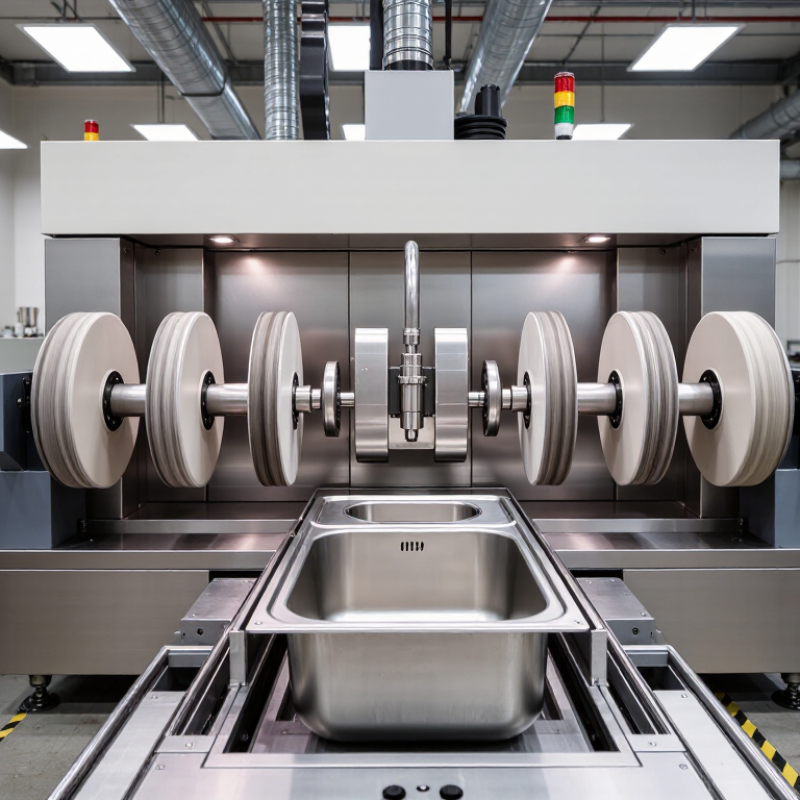
How to Choose CNC Mirror Polishing Machine for Kitchen Sink

Machine Types Used for CNC Mirror Polishing Kitchen Sinks

CNC mirror polishing kitchen sinks requires matching the machine type to the sink’s shape, material, and production volume. For stainless steel sinks, a CNC abrasive belt polishing machine is often used to remove forming lines and shallow scratches. It provides controlled pressure across flat bowls and curved corners. Belt width, spindle speed, and contact-wheel hardness directly affect the surface pattern.

For a brighter mirror finish, manufacturers commonly add a CNC buffing machine. This system uses rotating cloth wheels with polishing compounds. It can refine the surface after abrasive processing, especially around the rim and drain area. Wheel diameter matters. Larger wheels produce smoother contact, while smaller wheels reach tighter corners. An integrated belt-and-buffing machine can reduce handling between stages, but its setup may be less flexible.

Robotic polishing cells are suitable for varied sink models and frequent product changes. They can control tool angles along deep bowls and welded joints. Reliable results depend on accurate fixtures, force sensors, and programmed paths. In practice, I have found that polished samples can look excellent while the drain opening still shows uneven reflections. No setup is perfect. Operators should inspect reflected light from several angles and check edge thickness after polishing. A small trial run is wiser than trusting catalog specifications alone. Dust extraction, guarding, and routine wheel balancing also influence finish stability and workplace safety.

Key Sink Materials, Shapes, and Surface Requirements

How to Choose CNC Mirror Polishing Machine for Kitchen Sink

Material determines the polishing method. Stainless steel sinks, especially 304 and 316 grades, need controlled abrasive pressure and stable heat management. A machine with adjustable spindle speed can reduce discoloration and edge burning. Quartz composite sinks require different tooling, while ceramic surfaces may need gentler finishing methods. Do not assume one setup fits every material.

Shape matters just as much. Single-bowl sinks usually allow smoother tool paths and faster polishing. Double-bowl designs need accurate movement around narrow bridges and internal corners. Tight corner radii can expose weak programming or poor fixture support. Irregular handmade shapes are harder. They may need scanning, flexible fixtures, and more manual inspection. A mirror finish should look continuous across flat areas, curves, and drain openings. Surface goals must be defined before purchase, including gloss level, scratch limits, edge softness, and acceptable roughness.

Tips: Test the machine with your actual sink material and shape. Measure roughness before and after polishing. Inspect corners under bright angled light. Review abrasive consumption, cycle time, and operator adjustments. A small sample may look perfect, but production results can change. That is worth questioning. Choose repeatable control over impressive demonstrations, and leave room for future sink designs.

Essential CNC Machine Features and Performance Specifications

How to Choose CNC Mirror Polishing Machine for Kitchen Sink

A CNC mirror polishing machine should match the sink’s material, shape, and production volume. Stainless steel sinks often need controlled pressure and stable abrasive movement. Look for a rigid frame, low-vibration spindle, and accurate linear guides. These features help create an even reflective surface around bowls, corners, and drain openings.

Spindle speed matters, but higher speed is not always better. Choose a machine with adjustable speed and torque control for different abrasive wheels. A practical range may support both rough polishing and fine finishing. Check the machine’s positioning accuracy, repeatability, and working envelope. The table must hold large sink panels without visible movement. Tool changing should be quick, though fully automatic systems can increase maintenance demands.

From workshop experience, coolant delivery is easy to underestimate. A clear spray pattern prevents overheating and reduces surface discoloration. Effective chip collection also keeps abrasive dust away from guides and electrical parts. Test the control system before purchase. It should allow simple program adjustments for depth, speed, and polishing paths. Operators need emergency stops and guarded moving areas. Safety is not optional.

Inspect sample sinks under strong side lighting. Small waves may appear after polishing. I once accepted a smooth sample too quickly, then noticed uneven reflections near the corner radius. Ask for repeated test runs, not one perfect piece. Confirm power requirements, service access, calibration procedures, and spare-part availability. A machine that looks advanced may still perform poorly without consistent setup and skilled operation.

How to Choose CNC Mirror Polishing Machine for Kitchen Sink - Essential CNC Machine Features and Performance Specifications

Machine Feature Recommended Specification Why It Matters for Kitchen Sink Mirror Polishing What to Verify Before Purchase
Machine Configuration 3-axis or 5-axis CNC configuration
3-axis systems suit flat and standard bowl surfaces; 5-axis systems provide better access to complex radii and transitions.
Sink bowls, corners, drain areas, and curved edges require consistent tool contact. Additional controlled axes can reduce manual repositioning and improve polishing uniformity. Confirm the actual controlled axes, interpolation capability, rotary-axis range, and whether the machine can follow the sink geometry without excessive fixturing.
Effective Working Area At least 1,000 × 600 mm for common sink sizes
Select a larger envelope when processing double-bowl sinks, drainboards, or multiple parts in one setup.
The usable travel must accommodate the complete sink, fixture, polishing head, and tool clearance. Insufficient travel can cause additional setups and visible blending marks. Compare the usable travel—not only the external machine dimensions—with the largest sink size, fixture height, and maximum tool tilt.
Workpiece Load Capacity Approximately 150–300 kg or higher
Include the weight of the stainless-steel sink, dedicated fixture, clamps, and any support tooling.
A rigid support structure prevents vibration, movement, and deformation during grinding and polishing, particularly around large bowls and thin-gauge sheet metal. Request the rated static and dynamic load, fixture loading diagram, and evidence that the table remains stable during high-speed tool movement.
Spindle or Polishing-Head Speed Variable speed, commonly about 1,500–6,000 rpm
The suitable range depends on abrasive type, wheel diameter, compound, and stainless-steel finish requirements.
Adjustable speed allows the operator to balance cutting action, surface temperature, abrasive life, and final reflectivity across different polishing stages. Verify the continuous-duty speed range, speed stability under load, spindle runout, and compatibility with the intended abrasive tools.
Spindle Motor Power Typically 3–7.5 kW for sink polishing applications
Higher power may be needed for heavy grinding or large abrasive wheels.
Adequate motor power helps maintain stable contact pressure and speed when removing weld discoloration, scratches, and surface irregularities. Check rated continuous power, overload protection, cooling method, power consumption, and whether the motor can maintain torque at the selected speed.
Positioning Accuracy Around ±0.02–0.05 mm positioning accuracy
The practical result also depends on machine rigidity, calibration, fixture accuracy, and workpiece consistency.
Accurate positioning helps maintain uniform polishing paths and prevents uneven pressure at sink rims, corners, drain openings, and bowl transitions. Ask for a documented accuracy test, calibration procedure, ball-screw or linear-guide specifications, and repeatability results under normal operating conditions.
Repeatability Approximately ±0.01–0.03 mm
Consistent repeatability is essential when processing multiple sinks from the same program.
Good repeatability reduces variation in gloss, edge blending, and material removal between production batches. Evaluate test pieces from repeated cycles rather than relying only on a no-load specification sheet.
Abrasive and Tool Compatibility Support for flap wheels, abrasive belts, non-woven wheels, felt wheels, and polishing compounds
Tool diameter and interface should match the required surface geometry.
Stainless-steel mirror finishing normally requires several stages, such as scratch removal, fine polishing, and final buffing. Tool flexibility affects surface quality and cycle time. Confirm arbor or tool-holder dimensions, maximum tool diameter, automatic tool-change options, and availability of suitable tooling for internal and external surfaces.
Constant Contact Pressure Servo-controlled or pneumatic force regulation
A practical system should provide adjustable pressure and overload protection.
Controlled pressure prevents excessive material removal, local overheating, edge rounding, and inconsistent gloss on curved stainless-steel surfaces. Verify pressure adjustment range, response time, force-sensing method, and performance when the tool crosses different bowl radii.
CNC Control and Programming User-friendly CNC control with 3D path import
Useful functions include program storage, simulation, tool offsets, feed-rate adjustment, and automatic path recovery.
3D programming makes it easier to reproduce complex sink profiles and change polishing parameters without extensive manual teaching. Test importing common CAD/CAM file formats, editing tool paths, backing up programs, and creating repeatable recipes for different sink models.
Feed Rate Control Programmable feed rate, commonly about 500–3,000 mm/min
The optimal value depends on abrasive grit, contact pressure, curvature, and required finish.
Variable feed control allows aggressive scratch removal in early stages and slower, more controlled movement during final mirror polishing. Confirm independent control of feed rate, acceleration, deceleration, corner speed, and smoothing functions for curved tool paths.
Workholding and Fixturing Dedicated adjustable fixture with soft-contact supports
Vacuum, pneumatic, mechanical, or hybrid clamping may be used according to sink design.
A fixture must hold the sink securely without denting, scratching, distorting, or obstructing the areas that require polishing. Inspect clamping access, support points, quick-change capability, fixture repeatability, and compatibility with different bowl depths and drain positions.
Cooling and Dust Management Integrated coolant, mist, or extraction system suitable for dry or wet polishing
Stainless-steel dust and abrasive debris should be captured effectively.
Cooling limits heat tint and surface damage, while extraction reduces airborne dust, contamination of moving components, and operator exposure. Verify coolant filtration, chip and slurry collection, extraction airflow, access for cleaning, and compatibility with the selected polishing compounds.
Surface Finish Capability Consistent reflective finish, commonly targeted around Ra 0.05–0.20 µm
The final value depends on stainless-steel grade, starting surface, abrasive sequence, and inspection method.
A low and uniform roughness value supports a bright mirror appearance and reduces visible polishing lines, stains, and areas of uneven reflection. Request polished samples made from the same stainless-steel grade and measure several areas, including the rim, bowl, corners, and drain region.
Cycle Time and Production Capacity Evaluate complete cycle time rather than spindle time alone
Include loading, fixturing, tool changes, polishing stages, inspection, and unloading.
A fast spindle does not necessarily produce high output if setup, tool changes, or manual finishing account for most of the production time. Conduct a full production trial using the intended sink model and record cycle time, operator involvement, rework rate, and abrasive consumption.
Safety and Maintenance Fully enclosed working area with interlocks and emergency stops
Include guarding, overload monitoring, access doors, lubrication points, and maintenance alerts.
Polishing generates rotating-tool hazards, dust, noise, and debris. Proper guarding and maintenance access improve operator safety and machine availability. Check emergency-stop response, door interlocks, electrical protection, noise and dust controls, maintenance intervals, and access to replaceable components.
Utilities and Installation Requirements Confirm electrical supply, compressed air, extraction, coolant, and floor requirements
Typical pneumatic systems may require clean, dry compressed air at approximately 0.6–0.8 MPa.
Insufficient air pressure, unstable voltage, poor extraction, or an unsuitable floor can reduce polishing consistency and cause unexpected downtime. Obtain the complete utility schedule, connected load, air consumption, machine footprint, foundation requirements, ventilation needs, and installation tolerances.

How to Compare Automation, Tooling, Safety, and Maintenance

How to Choose CNC Mirror Polishing Machine for Kitchen Sink

How to Compare Automation, Tooling, Safety, and Maintenance

Automation should match your sink range, not your sales brochure. A servo-controlled polishing head can maintain pressure across curved bowls. Automatic loading also reduces handling marks and operator fatigue. However, full automation may waste money when models change weekly. Check cycle time, positioning accuracy, and setup time with your actual sink samples. Record results from several pieces, not one perfect test.

Tooling controls the final mirror finish. Ask whether fixtures support thin stainless steel without distortion. Inspect the abrasive wheel, polishing pad, spindle, and coolant delivery system. Their contact area should reach corners without leaving dull bands. A rigid fixture is essential. It prevents vibration around drain openings. Cheap tooling can quietly damage expensive sheets.

Safety deserves a physical inspection. Look for guarded moving parts, door interlocks, emergency stops, and clear status signals. Water and polishing compound can create slippery floors, so drainage needs attention. Maintenance is equally practical. Open the cabinet and check access to belts, bearings, filters, and electrical panels. A weekly cleaning schedule should be realistic for your team. Request maintenance records, spare-part lead times, and technician training. One overlooked weakness remains: operators may bypass inconvenient guards during production. That risk needs supervision, better machine design, and regular review.

Steps for Selecting a Machine That Fits Production Needs

Choosing a CNC mirror polishing machine starts with the sink, not the machine catalog. Record basin dimensions, corner radii, material grade, and target reflectivity. Stainless steel thickness changes clamping pressure and polishing time. Ask operators to measure daily output, not ideal output. A line producing 80 bowls daily may need a machine rated above that figure. Keep a buffer.

Request a sample trial using your actual sink blanks and abrasive sequence. Inspect the drain area, weld seams, corners, and flat panels under strong angled light. Measure surface roughness before and after polishing, then check consistency across at least ten pieces. Confirm spindle speed range, tool access, coolant control, dust protection, and automatic compensation. Small details matter. Verify cycle time with loading and unloading included.

Review training, maintenance access, spare-part availability, and electrical requirements before signing. The control system should store repeatable programs and allow approved adjustments without hidden settings. Ask for written acceptance criteria, including gloss variation and rejection limits. A supplier may show a perfect sample; production exposes weakness. I once underestimated manual loading time, and the calculated capacity failed during a busy shift. Build the layout around real people, gloves, inspection, and cleaning. Leave room for process changes, because the first polishing recipe is rarely final.

How to Choose a CNC Mirror Polishing Machine for a Kitchen Sink

A practical purchasing scorecard should prioritize throughput, finish consistency, part fit, process control, and operator safety. The chart shows a production-planning weighting for comparing suitable CNC mirror polishing machines.

Use these percentages as a starting point when evaluating machines for stainless-steel kitchen sinks. Confirm the working envelope against the largest sink size, verify repeatability with test parts, and measure actual cycle time using the required abrasive sequence and polishing quality standard.

FAQS

What should a CNC mirror polishing machine match?

Match it to the sink’s material, shape, thickness, and production volume. Record basin dimensions, corner radii, and target reflectivity. The machine should handle bowls, corners, drain openings, and flat panels.

Which mechanical features improve polishing quality?

Choose a rigid frame, low-vibration spindle, and accurate linear guides. These features help maintain even abrasive movement. Small waves matter.

Is a higher spindle speed always better?

No. Adjustable speed and torque are more useful than maximum speed. Rough polishing and fine finishing may need different settings. Test each abrasive wheel carefully.

How should a machine be tested before purchase?

Use actual sink blanks and the planned abrasive sequence. Inspect at least ten pieces under strong side lighting. Check weld seams, drain areas, corners, and flat panels.

What production details should be measured?

Measure real daily output, including loading and unloading. Add capacity above the expected target. I once underestimated manual loading time, and the calculation failed during a busy shift.

Why are coolant and dust collection important?

A clear coolant spray reduces overheating and surface discoloration. Chip collection protects guides and electrical parts from abrasive dust. Poor cleaning can quietly reduce consistency.

What control and safety functions are necessary?

The control system should adjust depth, speed, and polishing paths. It should store repeatable programs with approved settings. Emergency stops and guarded moving areas are essential.

What service information should buyers confirm?

Confirm power requirements, calibration procedures, maintenance access, training, and spare-part availability. Ask for written gloss variation and rejection limits. A perfect sample proves little.

Conclusion

Choosing the right Cnc Mirror Polishing Machine For Kitchen Sink begins with understanding your production goals, sink materials, shapes, sizes, and required surface finish. Different machines may be designed for stainless steel, aluminum, or other metal surfaces, while sink designs such as single-bowl, double-bowl, and custom forms can affect polishing access and consistency. Evaluate spindle power, polishing speed, control accuracy, working range, and the machine’s ability to deliver a uniform mirror finish without damaging edges or corners.

When comparing options, also consider automation level, tooling flexibility, abrasive compatibility, operator safety, maintenance access, and long-term operating costs. A suitable machine should support stable production, quick setup, reliable dust and debris management, and convenient replacement of consumable parts. Before making a decision, review sample polishing results, calculate expected capacity, assess available floor space, and confirm that the equipment can adapt to future product changes. Selecting a machine based on both current requirements and planned growth will improve efficiency, finish quality, and overall production value.


Liam

Liam

Liam is a dedicated marketing professional with a profound expertise in the industry, where he excels at highlighting the unique advantages of our core products. With a keen understanding of market trends and consumer needs, Liam frequently updates our company’s professional blog, providing......