Choosing a Cnc Hardware Polishing Machine requires more than comparing spindle speed, motor power, or catalogue photos. The real question is whether the machine can deliver stable surface quality across stainless steel handles, aluminium fittings, brass components, and complex hardware batches. Grand View Research estimates that the global metal finishing market will continue growing through 2030, supported by automation, tighter quality expectations, and demand for efficient production. Fortune Business Insights reports a similar expansion pattern, although market estimates differ by research method and product definition.
Consistency matters most.
Machining consultant Dr. Jeffrey A. Badger often stresses a practical manufacturing principle: “The machine is only as good as the process it repeats.” That observation applies directly to polishing. A reliable Cnc Hardware Polishing Machine should control pressure, abrasive movement, workpiece positioning, dust extraction, and inspection results. ISO 21920 also reinforces the importance of clearly defined surface-texture measurement, rather than relying only on visual judgement. A bright finish may still hide uneven polishing marks.
In real production, operators notice small failures first. A slightly rounded edge can affect assembly. Excessive heat can discolor stainless steel. Poor fixture design can leave unpolished corners. Supplier claims deserve testing.
A serious evaluation should include sample polishing, cycle-time records, abrasive consumption, maintenance access, and operator training. Energy use also deserves attention, especially as manufacturers pursue leaner production and lower waste. No machine is perfect. Even advanced automation needs careful programming, inspection, and periodic process review. The best supplier is not simply the one offering the fastest machine, but the one that can prove repeatable results under your actual workshop conditions.
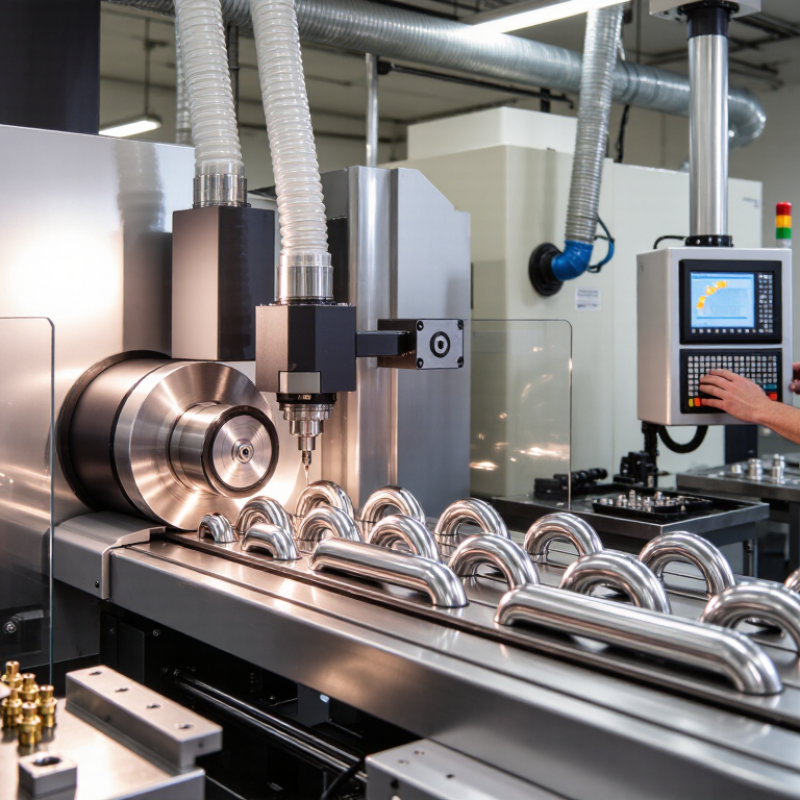
A CNC hardware polishing machine is an automated system that smooths and improves the surface of metal components. It uses programmed tool paths, controlled pressure, and abrasive wheels or belts. The process can polish stainless steel fittings, aluminum handles, brackets, and other precision hardware.
Unlike manual polishing, CNC equipment repeats the same movement with limited operator variation. A spindle holds the polishing tool, while fixtures keep each workpiece in position. Sensors and adjustable speed controls help manage heat, vibration, and surface contact. Excessive pressure may create rounded edges or visible burn marks. That detail is often overlooked.
In practical production, operators usually begin with a rough abrasive and change gradually to finer compounds. Cleaning between stages prevents coarse particles from scratching the surface again. A stable fixture is essential. It should resist movement without damaging the component. Cutting fluid or polishing compound may also improve consistency, depending on the material and finish required.
Choosing a suitable machine requires more than checking its polishing speed. Buyers should examine axis accuracy, fixture capacity, dust protection, maintenance access, and operator training requirements. Test samples provide stronger evidence than catalog claims. No setting works perfectly for every metal. That deserves honest review. Suppliers with documented testing, clear service procedures, and verifiable technical support are easier to trust.
| Data Dimension | Typical Information | Why It Matters | Supplier Evaluation Point |
|---|---|---|---|
| Machine Definition | A CNC hardware polishing machine uses computer-controlled axes, programmed tool paths, abrasive wheels, belts, brushes, or buffing heads to finish metal components. | It provides repeatable polishing movements and reduces dependence on manual operation. | Check whether the machine is designed for the actual workpiece geometry and finishing process. |
| Common Hardware Materials | Stainless steel, carbon steel, aluminum, brass, copper, zinc alloy, and other polishable metal parts. | Different metals require different abrasive grades, polishing pressure, speed, and compound selection. | Request test results using the same material and surface condition as the intended production parts. |
| Typical Applications | Handles, hinges, brackets, fittings, knobs, locks, bathroom hardware, automotive parts, and precision metal components. | Application-specific fixtures and tool arrangements improve consistency and reduce setup time. | Confirm that the supplier can provide suitable fixtures, tooling, and process samples. |
| Main Finishing Operations | Deburring, edge rounding, satin finishing, hairline finishing, pre-polishing, mirror polishing, and surface preparation before plating or coating. | The required finish determines machine configuration, abrasive sequence, and cycle time. | Ensure the supplier defines measurable surface requirements rather than using only terms such as “high quality.” |
| Control System | A CNC controller typically manages axis movement, spindle or polishing-head speed, feed rate, tool paths, and stored programs. | Programmable settings support repeatable results across production batches. | Verify program storage, operator interface, parameter access, alarm functions, and training support. |
| Number of Controlled Axes | Common configurations include 3-axis systems, while more complex parts may require 4-axis, 5-axis, or additional rotary movement. | More axes can improve access to curved, angled, or multi-sided surfaces. | Select the fewest axes that can complete the required surfaces reliably to control cost and maintenance complexity. |
| Polishing Head or Tooling | Possible tooling includes abrasive belts, flap wheels, grinding wheels, sisal or cotton buffs, wire brushes, and dedicated polishing pads. | Tool selection affects material removal, surface texture, gloss, heat generation, and consumable life. | Ask for a complete tooling list and a clear replacement procedure. |
| Workpiece Handling | Parts may be held with mechanical fixtures, vacuum fixtures, chucks, clamps, nests, or custom jigs. | Stable positioning prevents vibration, scratches, uneven polishing, and dimensional variation. | Confirm fixture repeatability, changeover time, and compatibility with the complete part range. |
| Typical Production Mode | Single-piece, small-batch, multi-part fixture, or continuous production, depending on the machine and loading method. | The loading method has a direct effect on labor requirements and hourly output. | Compare manual loading, semi-automatic loading, and robotic integration according to expected volume. |
| Cycle Time | Cycle time varies substantially with part size, geometry, starting roughness, target finish, tooling, and number of operations. | A shorter cycle is not useful if it produces inconsistent finish quality or excessive rework. | Use a witnessed sample test to record actual loading, polishing, inspection, and unloading time. |
| Surface Quality Measurement | Surface results may be assessed by visual standards, gloss comparison, roughness values such as Ra, or customer-approved reference samples. | Defined inspection criteria make quality comparisons more objective. | Agree on inspection equipment, sampling frequency, acceptance limits, and reference samples before purchase. |
| Automation Compatibility | Options may include automatic loading, unloading, part detection, tool compensation, dust collection, and connection to upstream or downstream equipment. | Automation can improve throughput, operator safety, and process consistency. | Check communication interfaces, safety interlocks, layout requirements, and future expansion capability. |
| Dust and Waste Management | Dry polishing can generate metal dust and abrasive particles; wet processes may produce slurry or contaminated liquid. | Effective extraction, filtration, guarding, and housekeeping reduce health, fire, and contamination risks. | Request extraction requirements, filter specifications, maintenance intervals, and applicable safety documentation. |
| Electrical Requirements | Power supply requirements depend on motors, pumps, heaters, dust collectors, and auxiliary equipment; industrial systems commonly use three-phase power. | Incorrect voltage, frequency, or total load planning can delay installation. | Confirm rated voltage, frequency, total connected load, air requirements, and installation conditions. |
| Maintenance Requirements | Routine tasks may include cleaning, lubrication, abrasive replacement, fixture inspection, filter service, belt tension checks, and calibration. | Preventive maintenance helps preserve finish consistency and equipment availability. | Evaluate spare-parts availability, maintenance manuals, remote support, and technician response time. |
| Safety Features | Important features may include guarding, emergency stops, door interlocks, overload protection, spark control, dust extraction, and clear operating instructions. | Polishing involves rotating tools, abrasive particles, noise, and possible heat or sparks. | Review the risk assessment, safety circuit, documentation, and compliance requirements for the destination country. |
| Best Supplier Selection Criteria | The most suitable supplier should demonstrate process knowledge, verified sample quality, stable machine construction, transparent specifications, reliable support, and suitable documentation. | A machine should be judged by total production performance rather than purchase price alone. | Compare sample results, total cost of ownership, delivery scope, warranty terms, training, spare parts, and after-sales service. |
The supplier should provide spindle-speed ranges, abrasive compatibility, cycle-time data, and repeatability results. Ask for written calibration records. Price alone proves little.
Send your actual metal grade and workpieces for sample testing. Inspect edges, corners, grooves, and curved surfaces under bright, angled light. One perfect sample is not enough.
Three sample batches reveal consistency better than one polished demonstration piece. Measure surface gloss, scratches, cycle time, and finish variation. The comparison may expose unstable tooling.
Inspect the frame, spindle, guide rails, polishing head, fixtures, and electrical cabinet. A rigid frame can reduce vibration on small metal parts. Weak fixtures create uneven results.
Request video evidence or conduct a longer production test. Monitor polishing speed, abrasive use, noise, heat, and surface consistency. Short demonstrations can hide later scratches.
Confirm installation, operator training, spare parts, maintenance guidance, and remote diagnosis. Ask for the service response time in writing. Support can be vague.
Confirm voltage, safety guarding, manuals, inspection records, warranty terms, and export documents. Check whether the equipment matches your workshop conditions. Small omissions become expensive.
No. A quality certification may show process discipline, but it cannot prove your required finish. Test the actual material, abrasive, fixture, and operator settings. Keep reasonable doubt.
Choosing the right Cnc Hardware Polishing Machine requires a clear understanding of its function, working process, and supplier capabilities. This automated equipment uses programmed movements, polishing tools, and controlled pressure to create consistent surface finishes on hardware components. Reliable suppliers should provide stable machine structures, accurate control systems, efficient motors, adaptable polishing configurations, and safety-focused designs. Buyers should also evaluate polishing consistency, production capacity, energy use, maintenance requirements, and compatibility with different materials and workpiece shapes.
A careful purchasing decision should include a review of technical specifications, sample polishing results, customization options, delivery arrangements, installation guidance, operator training, and after-sales support. Clear communication about production goals and expected finish quality can help ensure the machine matches actual operating needs. By comparing quality, performance, service responsiveness, and total ownership costs, companies can select a dependable solution that improves productivity, reduces manual work, and supports long-term manufacturing efficiency.

 Dingzhu auto